Class, education, and democracy - The impact of cuts to adult education

Despite our position closer to the middle of the twenty-first century than to its beginning, discussions of class remain one of Britain’s most thorny issues. Those traditional indicators of class – occupation, income, culture – have become far less clear. Now, unlike any point during the previous two centuries, the question of who is what has become much more uncertain, and a Labour tweet attempting to re-claim their role as the ‘party of the working class’ raises interesting questions for adult education.
With the rise of the Green Party, Labour is coming under threat from the left for the first time since, arguably, its creation. National polling has the Greens ahead, and the recent election of Hannah Spencer in Gorton and Denton has done enough for the newspapers to roll-out the ‘shockwaves through British politics’ cliche. It is this anxiety that led the Labour Party to recently tweet (if to tweet is still the right verb in an age of X) that the Labour Government was the most working-class in UK history. It’s an interesting statement and not one I wish to challenge, but it contains rather a lot that needs unpacking. Why does it need saying and what does it mean in 2026?
The claim of being “the most working‑class government in the history of the UK” matters because the traditional pathways that once brought working‑class people into politics — especially union education — have largely disappeared. Background may still be present, but the lived experience and educational routes that once shaped political life are fading.
The absence of any real challenge from the left, outside its own ranks, allowed Labour to focus on the centre-ground from the 1990’s onwards, particularly with the rise of New Labour. But this new, more uncertain world has prompted it to shout about its working-class credentials. There are many reasons why it may see the need to do so now, but perhaps the simplest explanation is this: Labour may be working class, but it doesn’t really look or feel it.
Starmer caused much amusement during the general election campaign with the regularity with which he reminded us that his father was a toolmaker. His aim was to demonstrate that he was no out-of-touch lawyer from North London – a reasonable approach when the public were tired of leaders who had no experience of ‘real’ life. As the tweet claims, he is surrounded by others with similar backgrounds, some with experience of greater hardships. The problem is that while the Cabinet of 1945 contained coal miners, tailors and weavers – workers that could be listed in the dictionary definition of working-class – today’s is generally composed of lawyers, economists, journalists, and special advisers. Working class in upbringing, certainly, but not in profession. Of the current Cabinet, all but one of the twenty-two attended university straight after school – ten of these at Oxford or Cambridge. [1]
Going to university is no crime, nor should it be used as a criticism. I’ve experienced reverse-snobbery myself. One of my first experiences of work was at a steelworks in Rotherham where I was meeting the manager to discuss support for the men who were to lose their jobs. The union steward, Dave, a quiet and decent man, welcomed me to the site and took me to the offices – seemingly undecorated for 40 years – where we were shown into the boss’ office. He didn’t stand, smile, or offer his hand. Instead, I received an abrupt: ‘tha’s been to university’. Startled, I wasn’t sure what this meant, only that it was an insult. A moment passed before Dave leaned in and, barely above a whisper, made his point: ‘Our Dylan’s at university’. An attempt by a manager to divide us along class grounds foundered on a failure to understand a working-class respect for education and pride in his son’s achievements.
University education has now expanded so that more young people than ever now attend. This is something to celebrate (although the benefits of this require a separate debate). But what is missing today among those working-class politicians are the voices of those who were unable to go to university, or never saw it as an option – those who went straight into work and came to politics later in life, rather than a career option. It is a cause of huge celebration that more Cabinet members in 2024 were educated in comprehensive schools than ever before, but what of those with other kinds of experiences? The problem is not that working‑class MPs go to university, but that those who never had the chance to do so seem absent.
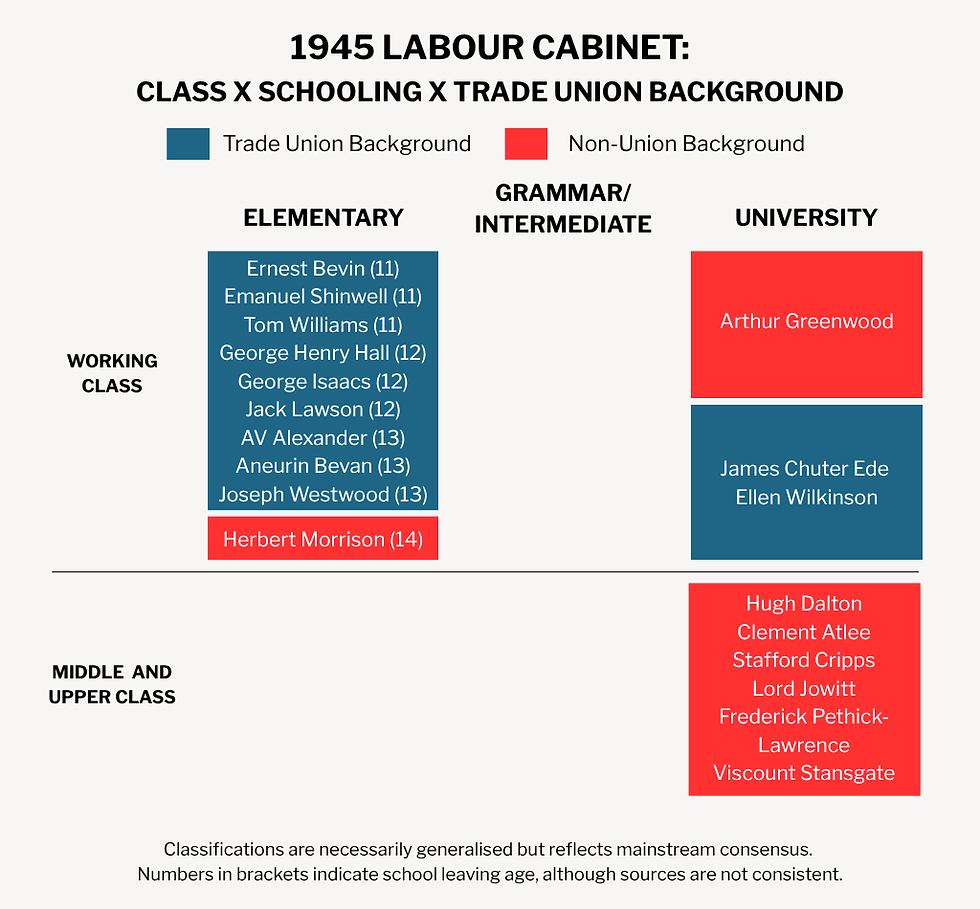
Hannah Spencer’s election is intriguing for many reasons. Her story mirrors that of many Labour MPs of the past: leaving school at 16, taking up a trade (in her case, plumbing) and then later becoming active in politics. To be fair, some Tories have taken this route too, but this feels different. Her election was greeted by a college chair with the words, ‘a lifelong learner is our newest MP’; that this is considered newsworthy is significant in itself. The image (left) shows the backgrounds of the 1945 Cabinet, with only a few having attended university. ‘Lifelong learner’ is not a phrase that was used to describe Nye Bevan, yet it was his union that led him to the Central Labour College and to chair Tredegar Miners’ Institute Library. This is not idealising that Cabinet of ’45, but about routes into politics.
It’s easy to blame the Labour Party for this shift (again, another debate), but perhaps it is the trade union movement that should reflect most deeply. There are no coal mines today. Shipyards, car factories, and steel manufacturing are shadows of what they once were. From these came numerous MPs, with the trade union movement their route. The trade unions though still represent 6.5 million workers – hardly insignificant – but do they still provide an educational route into politics, not as a stepping-stone but as a calling? Ruskin College, Coleg Harlech, Northern College, miners’ day-release schemes, and the unions’ own programmes brought working men and women together from all corners of the United Kingdom. I was told the story of a man who spent a Friday riding in the back of a van with his workmates, and by Monday was shaking his head in disbelief at finding himself studying among the gardens of Ruskin College in Oxford – an experience many former Ruskin students recalled.
But does this matter? Well, I believe that to understand the power of adult education requires the individual to feel it, not simply to understand it. Those previous Labour governments were filled with men and women who had felt its influence, both from their own paths and by coming from that world. Gordon Brown, Neil Kinnock, and Robin Cook had been WEA tutors, whilst Mo Mowlem and David Blunkett had taught adults. They had seen first-hand how lives were changed and understood this as a form of empowerment. Today, however, we appear to have a government that does not feel the power of lifelong learning, viewing the Adult Skills Fund as a vehicle for ‘employability skills’ – getting adults ‘work-ready’ – rather than as a means of offering culture, confidence, and support with loneliness and mental health. Yet from the early 19th century trade, unionists fought for education, not only for employment, but for culture and leisure. A key element of the campaigns of Will Thorne and Tom Mann were to reduce the working day so that workers could experience time to learn and not be, in Mann’s words, ‘riveted to earth’.
This trade union education need not be Political with a capital ‘P’, but education in its widest sense – and all education is political. Historically, union education emphasised public speaking, economics, and critical thinking as key subjects that we have now eschewed, but also educational pursuits that foster community and relationships among workers whether that be crafts or disability awareness. Democracy requires all sectors of society to be represented in its institutions, and it was the union movement that offered this to working people. A collapse in trade union education undermines our democracy, and fosters alienation in society. An alienation that will be welcomed elsewhere.
[1] Peter Kyle is the lone Cabinet member to not attend university straight from school. Instead his Dyslexia meant he left school with no ‘usable’ qualifications and struggled to make it to university until his early 20s.


Comments